

It’s 3 a.m. Your tongue feels stuck to the roof of your mouth, and the water glass on your nightstand is empty. By lunch, a perfectly ordinary cracker feels like a mouthful of sawdust. It’s funny how something you’ve barely thought about can suddenly decide what you order for lunch. Some women notice a drier mouth for the first time in peri-menopause or after menopause.
Meet your mouth’s built-in body-gaurd
Saliva turns dry crumbs into something you can swallow and helps you taste what you’re eating. Between bites, it washes away bits of food and sugars, helps neutralize acids, and delivers minerals that strengthen enamel. When saliva runs low, teeth lose some of that protection and cavities can become more likely.
IN THIS ARTICLE
Meet your mouth’s built-in body-gaurd
Where hormones fit
So what can you do about dry mouth?
References
Where hormones fit
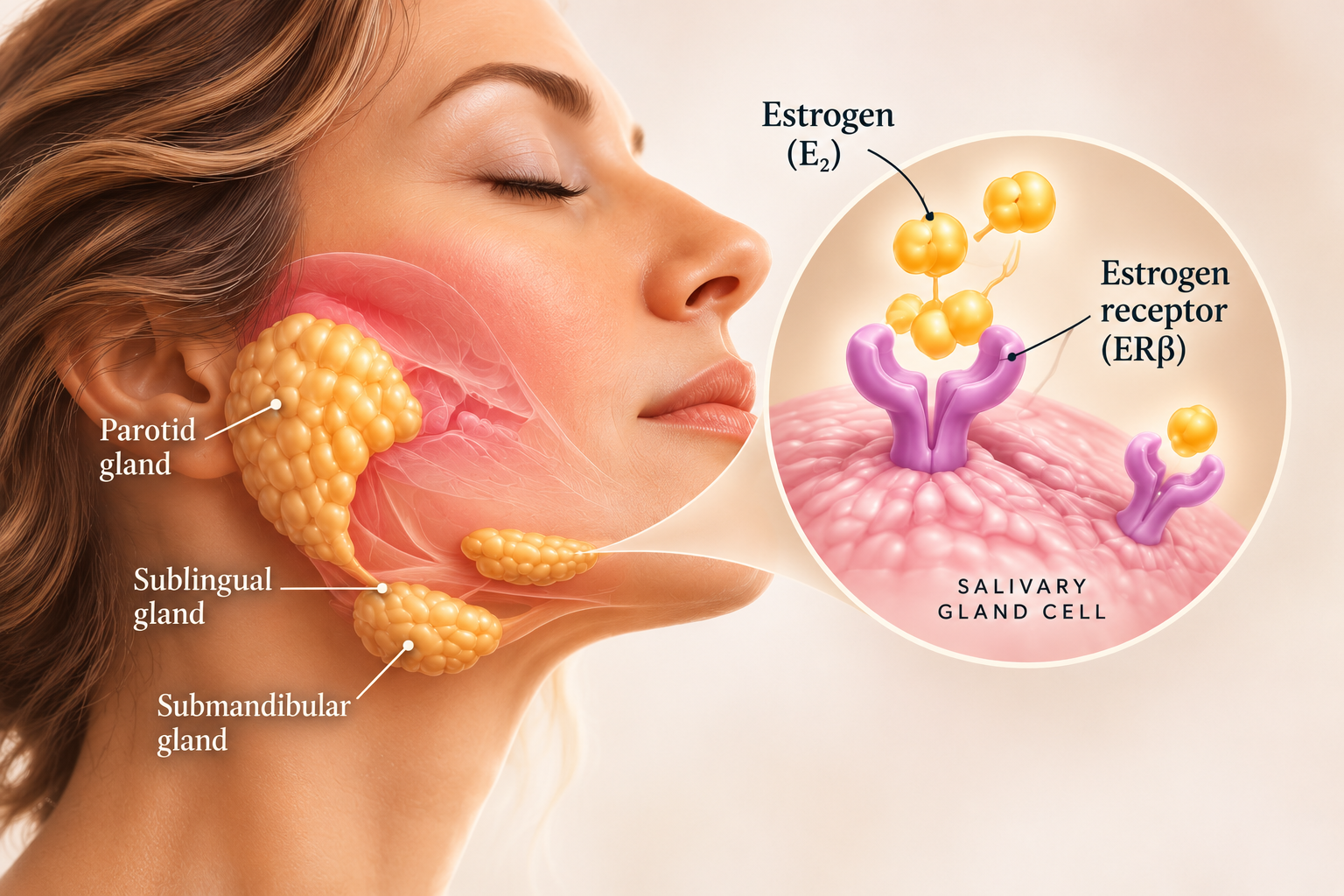
So where does menopause come in? Women in perimenopause, menopause, and beyond often report experiencing dry mouth. And hormones may be part of the picture. Your salivary glands have tiny docking sites for estrogen, called receptors, which suggests that changing hormone levels could influence how your mouth feels and functions. But the research isn't entirely clear. Studies measuring saliva production have found mixed results, and you can experience a dry mouth even when your glands are producing a measured "normal" amount of saliva.
So, could menopause hormone therapy (MHT) help? Possibly. Some women have reported improvements in dry mouth symptoms after starting MHT, but the evidence is still limited. That means dry mouth alone generally isn't a reason to begin hormone therapy. Instead, it's worth looking at the bigger picture. Hormonal changes may be one piece of the puzzle, alongside medications, medical conditions, and other contributing factors. Understanding what's behind the dryness can help you and your healthcare providers find relief while protecting your teeth and oral health from the effects of reduced saliva.
So what can you do about dry mouth?
Start with a conversation. Hormone changes are one possibility. Medications and health conditions can play a part, too, sometimes at the same time. Tell your dentist and medical provider when the dryness started, when it’s worst, and what else changed around that time. Bring your medication and supplement list. Those clues help us work out what might be contributing, what could bring relief, and whether we need a closer look.
Make yourself more comfortable in the meantime. Keep water handy for sips between bites. Sugar-free gum can encourage saliva flow if chewing feels comfortable, and a dry-mouth gel or spray may offer temporary relief. If you wake up parched, a bedroom humidifier may help.
Give your teeth backup. Brush twice a day with fluoride toothpaste. If dryness keeps coming back, ask your dentist whether extra fluoride would help protect your teeth or if additional preventative measures are needed to prevent decay.
“I keep waking up with a dry mouth. Can we talk about why?” is plenty to get the conversation started
And those conversations matter. There is still much to learn about how hormonal changes affect women's oral health, and we believe those questions deserve more attention. At Lit Dental, we're committed to continuing our education, advocating for research that advances our understanding of women's health, and bringing that knowledge into the care we provide.
Because the more we understand, the better we can care for you.
KEY TAKEAWAYS
Saliva Protects your Teeth, helps you tast and swallo, and keeps your mouth comfortable.
Hormonal changes can play a role in dry mouth, but other factors, like medications and health conditions, can also contribute.
Simple strategies, a review of possible causes and a conversation with your care team can help you find relief and protect your oral health.

Coming Soon….
Article References
1. Ciesielska A, Kusiak A, Ossowska A, Grzybowska ME. Changes in the Oral Cavity in Menopausal Women—A Narrative Review. Int J Environ Res Public Health. 2022;19(1):253. DOI
2. Jacob LE, Krishnan M, Mathew A, Mathew AL, Baby TK, Krishnan A. Xerostomia – A Comprehensive Review with a Focus on Mid-Life Health. J Midlife Health. 2022;13(2):100–106. DOI
3. Välimaa H, Savolainen S, Soukka T, et al. Estrogen receptor-beta is the predominant estrogen receptor subtype in human oral epithelium and salivary glands. J Endocrinol. 2004;180(1):55–62. DOI
4. Florezi GP, Vanelli L, de Moraes FP, et al. Xerostomia in the menopausal transition: are we measuring menopause or its comorbidities? Clinics. 2026;81:101154. DOI
5. Ashraf M, Kamp E, Musbahi E, DeGiovanni C. Menopause, skin and common dermatoses. Part 4: oral disorders. Clin Exp Dermatol. 2022;47(12):2130–2135. DOI
6. Areal-Quecuty V, Segura-Egea JJ, Simón-Soro A, et al. Dental Caries Status in Postmenopausal Women: Systematic Review and Meta-Analysis. J Clin Med. 2025;14(6):1837. DOI
7. Wang L, Zhu L, Yao Y, Ren Y, Zhang H. Role of hormone replacement therapy in relieving oral dryness symptoms in postmenopausal women: a case control study. BMC Oral Health. 2021;21(1):615. DOI
8. National Institute of Dental and Craniofacial Research. Dry Mouth. Patient guidance on symptoms, causes and practical care.